
🤔 Why People Confuse Deodorant and Antiperspirant
Most people use the words “deodorant” and “antiperspirant” like they mean the same thing.
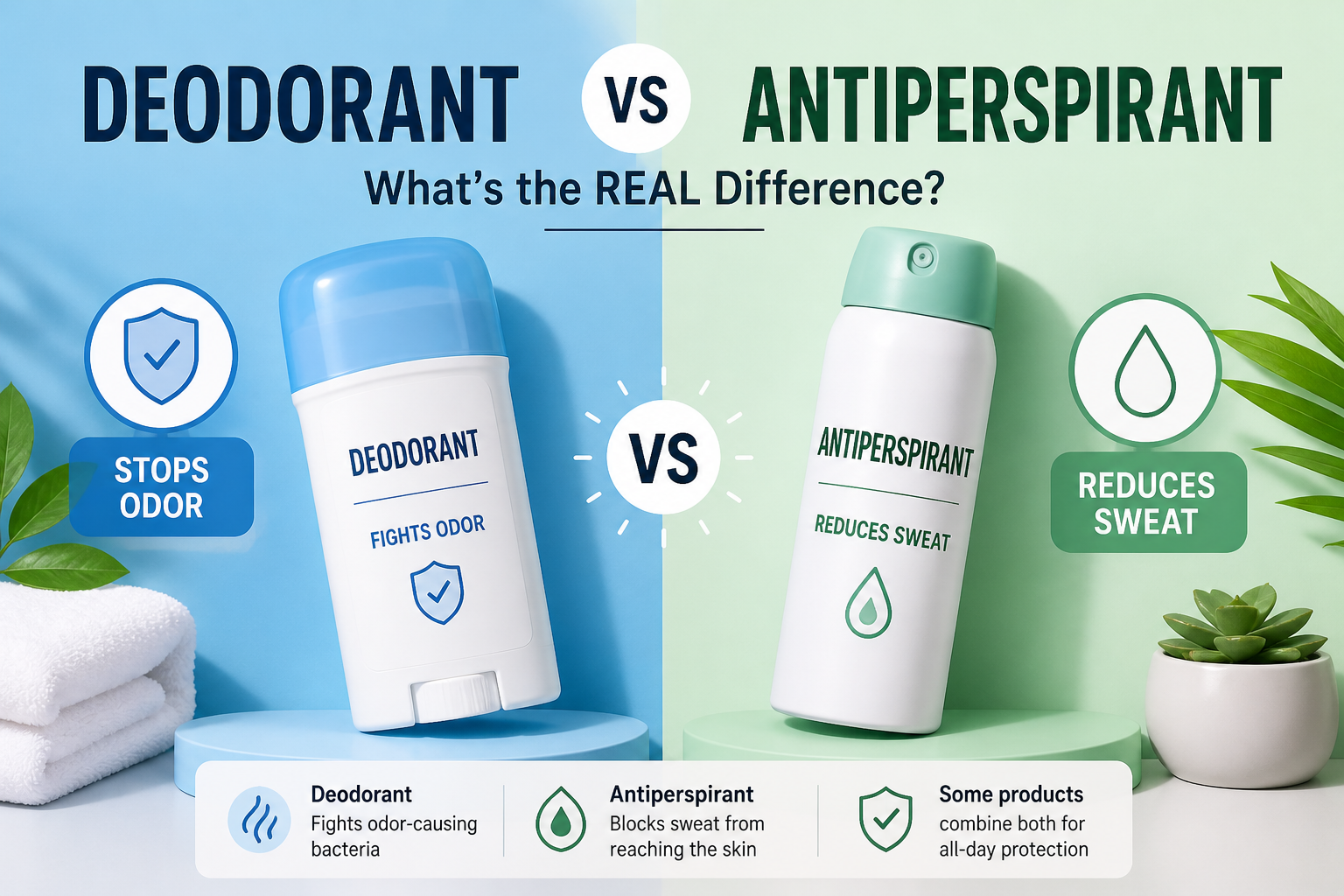
But they actually do two very different jobs:
- Deodorant = fights odor
- Antiperspirant = reduces sweat
And here’s something many people don’t realize:
👉 Many products today are actually BOTH at the same time.
Understanding the difference can help you:
- smell fresher longer
- sweat less
- avoid irritation
- choose products that actually fit your body
🧪 What Causes Underarm Odor in the First Place?
Surprisingly, sweat itself usually has very little smell.
The odor happens when:
- Sweat mixes with bacteria on your skin
- The bacteria break down sweat proteins
- That process creates body odor
That’s why simply “covering sweat” isn’t always enough.
🧴 What Does Deodorant Actually Do?
Deodorants are designed to:
- reduce odor-causing bacteria
- mask odor with fragrance
- sometimes absorb moisture slightly
But:
❌ They do NOT stop sweating.
You will still sweat normally while wearing deodorant.
Many deodorants use:
- antibacterial ingredients
- alcohol
- fragrance
- baking soda
- plant-based ingredients
Some newer deodorants are aluminum-free and marketed as “natural.”
💦 What Does Antiperspirant Do?
Antiperspirants are different because they actually reduce sweating.
They contain aluminum-based compounds that temporarily block sweat glands near the skin surface.
That means:
- less sweat reaches the skin
- less moisture feeds bacteria
- less odor develops
So antiperspirants usually help with BOTH:
- sweating
- smell
Most clinical-strength products are antiperspirants.
Dermatologists explain that antiperspirants reduce sweating using aluminum salts, while deodorants mainly target odor-causing bacteria.
🔍 Quick Comparison Table
| Feature | Deodorant | Antiperspirant |
|---|---|---|
| Stops odor | ✅ Yes | ✅ Yes |
| Reduces sweat | ❌ No | ✅ Yes |
| Contains aluminum | Usually no | Usually yes |
| Best for heavy sweating | ❌ No | ✅ Yes |
| Good for odor only | ✅ Yes | ✅ Yes |
| Can help sweat stains | ❌ No | ✅ Yes |
😅 Which One Should You Choose?
Choose Deodorant If:
- you mainly care about odor
- you don’t sweat heavily
- you prefer aluminum-free products
- your skin gets irritated easily
- you want a more natural approach
Choose Antiperspirant If:
- you sweat through shirts
- you live in a hot climate
- sweat causes odor quickly
- you exercise often
- you have excessive sweating (hyperhidrosis)
🌙 Why Dermatologists Recommend Applying Antiperspirant at Night
This surprises a lot of people.
Antiperspirants usually work BEST when applied before bed.
Why?
Because sweat glands are less active at night, which allows the aluminum compounds to form better sweat-blocking plugs.
That means:
✅ better protection
✅ longer-lasting dryness
✅ less odor the next day
Dermatologists commonly recommend nighttime application for maximum effectiveness.
🚿 Can You Use Both Together?
Yes — many people do.
A common routine is:
- antiperspirant at night
- deodorant in the morning
This helps control both:
- sweating
- odor
Some products already combine both functions in one formula.
🧼 Common Mistakes People Make
❌ Applying to Wet Skin
Always apply to completely dry underarms.
❌ Using Too Much Product
More product doesn’t always work better.
❌ Applying Right After Shaving
This can cause burning and irritation.
Wait a little before applying.
❌ Expecting Deodorant to Stop Sweat
It won’t.
If sweat is the main problem, you probably need an antiperspirant.
🏋️♀️ What About “Natural” Deodorants?
Natural deodorants can help with odor, but they usually:
- do NOT stop sweat
- may require reapplication
- may not work well for heavy sweaters
Some people love them.
Others switch back to antiperspirants after workouts or hot weather.
The best option depends on:
- your sweat level
- skin sensitivity
- lifestyle
- climate
✅ Final Thoughts
Here’s the simplest way to remember it:
👉 Deodorant fights smell
👉 Antiperspirant fights sweat AND smell
Neither one is universally “better.”
The right choice depends on:
- how much you sweat
- how sensitive your skin is
- whether odor or wetness bothers you more
For many people, combining both strategies gives the best results.
📚 Sources
- American Academy of Dermatology
- American Cancer Society
- National Cancer Institute
- Allure — “Antiperspirant vs. Deodorant”
- Real Simple — “Deodorant vs Antiperspirant”
- Washington Post Wellness — nighttime antiperspirant guidance
Leave a Reply